
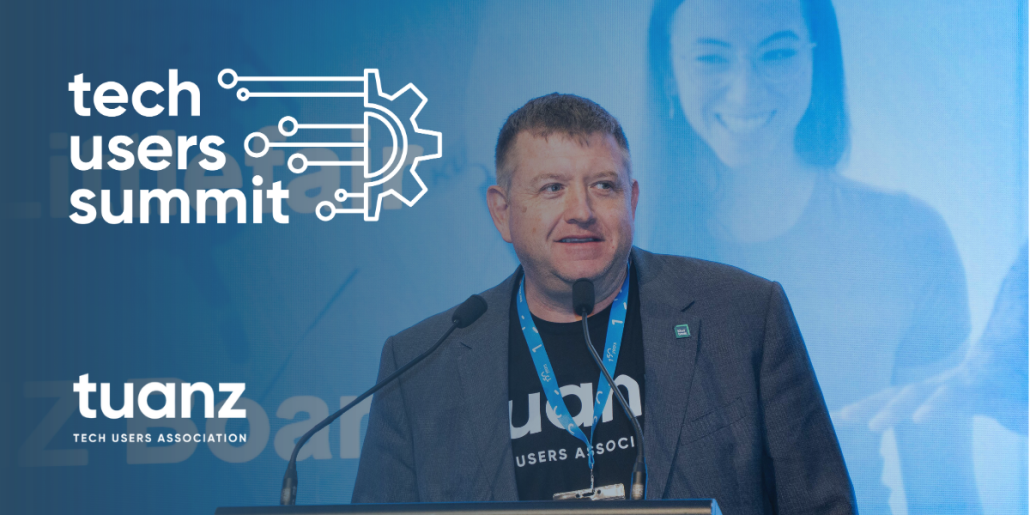
Aotearoa at a Generational Crossroads: TUANZ calls out political short-termism and encourages politicians to work on an enduring digital strategy
Media Release
14 October 206
AUCKLAND — At yesterday’s TUANZ Tech Users Summit 2026, technology leaders warned that New Zealand risks squandering its vast digital and economic potential if political leaders continue to reset the nation’s technological direction every three years. While digital innovation already drives over $17 billion in annual exports and offers an estimated $76 billion economic transformation through artificial intelligence, summit convenors highlighted that national progress remains severely constrained by fragmented, short-term political cycles and piecemeal party policies.
Addressing summit delegates, Tech Users Association of New Zealand (TUANZ) Chief Executive Craig Young emphasised that technology investment, digital transformation, and workforce building require long-term cross-party alignment. “We can’t afford to reset our national direction every three years while our global competitors move ahead,” said Young. “What’s urgently needed is certainty, coordination, and commitment across political lines to deliver a joined-up national strategy.”
Setting the core agenda for the summit, TUANZ Board Member Haley Mortimer outlined three strategic themes required to build healthy digital foundations for Aotearoa: empowering people, building resilience, and earning trust through innovation. Mortimer highlighted significant equity gaps across the country, noting that 1 in 10 Kiwi households still lacks internet access, while New Zealanders lose over $200 million annually to online scams and 35% of small businesses suffer from insufficient cyber resilience. She stressed that digital capability and cybersecurity can no longer be treated as elective IT compliance tasks, but as fundamental issues of national economic resilience and human dignity. “While New Zealand will never be the largest tech market in the world, we can become one of the most trusted places in the world to innovate,” Mortimer stated. “Human oversight, data sovereignty, and digital inclusion must be designed into our systems so that technology supports better decisions without removing human accountability.”
To translate these strategic priorities into actionable advocacy ahead of the upcoming election cycle, TUANZ highlighted the re-release of its comprehensive election policy stance consolidated into a single document: the TUANZ Position Statements for the 2026 National Election. Combining individual position papers originally published throughout June and July, the unified manifesto presents political parties and decision-makers with a blueprint spanning digital equity, cybersecurity, data governance, and workforce development.
Marking four decades of championing user-focused technology alongside these policy calls, TUANZ also highlighted the official release of its 40th Anniversary History booklet, documenting 40 years of driving major national infrastructure transformations from the rollout of Ultra-Fast Broadband to mobile number portability. TUANZ challenged current and future political leaders to move past piecemeal party policies and commit to an enduring, cross-party national technology strategy that prepares Aotearoa’s workforce and communities for the generations ahead.
ENDS


